|
Researching
World War II
Unit
Histories, Documents
Monographs, Books and Reports on CD
PDF Remastered and Keyword Searchable
|
|
| |
45th
Infantry
"Thunderbird"
Division
|
|
Order
of Battle
|
157th Infantry
Regiment
179th Infantry Regiment
180th Infantry Regiment
45th Infantry Division Artillery
158th Field Artillery Battalion
(105mm)
160th Field Artillery Battalion
(105mm)
171st Field Artillery Battalion
(105mm)
189th Field Artillery Battalion
(155mm)
45th Reconnaissance Troop
(Mechanized)
120th Engineer Combat Battalion
120th Medical Battalion
45th Infantry Division Military
Police Platoon
45th Infantry Division Special
Troops
45th Quartermaster Company
45th Signal Company
700th Ordnance Light Maintenance
Compan
45th Counter Intelligence
Corps Detachment
|
Casualties
| Killed
- 1,510
Wounded - 7,246
Missing - 1,436
Captured - 266
Battle Casualties - 10,458
Non-Battle Casualties - 15,
991
Total Casualties - 26,449
|
Commanders
Maj.
Gen. William S. Key
September 1940 - October
1942
Maj. Gen. Troy H.
Middleton
October 1942 - December
1943
Maj. Gen. William
W. Eagles
December 1943 - December
1944
Maj. Gen. Robert
T. Frederick
December 1944 - September
1945
Brig. Gen. Henry
J. D. Meyer
September 1945 - Inactivation
|
Campaigns
| Sicily |
9
Jul - 17 Aug 43 |
| Naples-Foggia |
9
Sep 43 - 21 Jan 44 |
| Anzio |
22
Jan - 24 May 44 |
| Rome-Arno |
22
Jan - 9 Sep 44 |
| Southern
France |
15
Aug - 14 Sep 44 |
| Rhineland |
15
Sep 44 - 21 Mar 45 |
| Ardennes-Alsace |
16
Dec 44 - 25 Jan 45 |
| Central
Europe |
22
Mar - 11 May 45 |
Medals
Medal
of Honor Recepients - 8
Distinguished Service Cross
- 54
Legion of Merit - 30
Silver Star - 1,230
Soldiers Medal - 36
Bronze Star - 3,314
Air Medal - 53
Distinguished Unit Citations
- 7
Days
of Combat
- 511
|
Medal of Honor
Recepients
Van
T. Barfoot, 2nd Lt.
157th Infantry - 45th Infantry
Division
nr. Carano, Italy
May 23, 1944
Ernest
Childers, 2nd Lt.
45th Infantry Division
Oliveto, Italy
September 22, 1943
Almond
E. Fisher, 2nd Lt.
Company E, 157th Infantry
- 45th Infantry Division
nr. Grammont, France
September 12-13, 1944
William
J. Johnston, Pfc.
Company G, 180th Infantry
- 45th Infantry Division
nr. Padiglione, Italy
February 17-19, 1944
Jack
C. Montgomery, 1st Lt.
45th Infantry Division
nr. Padiglione, Italy
February 22, 1944
James
D. Slaton, Cpl.
157th Infantry - 45th Infantry
Division
nr. Oliveto, Italy
September 23, 1943
Jack
L. Treadwell, Cpt.
Company F, 180th Infantry
- 45th Infantry Division
nr. Nieder-Wurzbach, Germany
March 18, 1945
Edward
G. Wilkin, Cpl.
Company C, 157th Infantry
- 45th Infantry Division
Siegfried Line in Germany
March 18, 1945
|
|
|
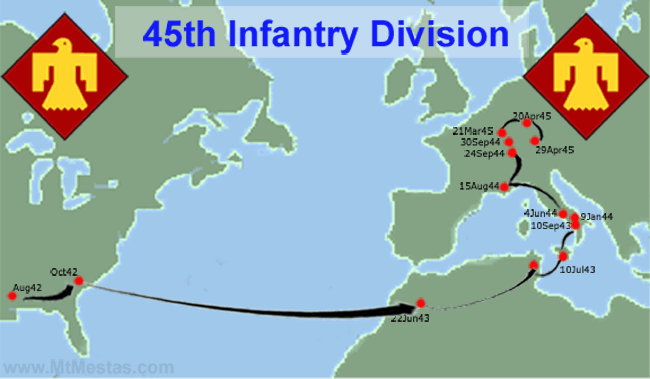
|
1942 |
|
| 14
Jan- |
The
first contingent of the 34th Division
embarks at Brooklyn. |
1940 |
|
16
Sep- |
The
45th Infantry Division was federalized
into the Active duty force. |
1942 |
|
15
Aug- |
Division
reconstituted as the 45th Airborne
activated at Camp Claiborne, Louisiana. |
Oct-
|
Division
moved to Fort Bragg, North Carolina
and began its training under the Airborne
Command and trained at Fort Sill,
Camp Barkeley, Fort Devens, Pine Camp
and Camp Pickett. The division trained
in amphibious assault techniques at
Fort Devens in preparation for the
invasion of Italy. |
1943 |
|
8
Jun- |
The Division sailed for the Mediterranean
region. |
22
Jun- |
The
45th Division landed in North Africa
and trained at Arzew, French Morocco. |
10
Jul- |
The
Division was one of the leading units
in the amphibious assault on Sicily.
|
26
Jul- |
Division
fought for four days to defeat Italian
and German forces on Motta Hill. |
1
Aug- |
The
Division withdrew from the front line
for rest and rear-guard patrol duty.
|
10
Sep- |
The
Division conducted its second landing
at Agropoli and Paestrom. |
17
Sep- |
The
45th pushed to the Calore River after
a week of heavy fighting. |
20
Sep- |
American
forces were finally able to break
out and establish a more secure beachhead. |
3
Nov- |
Division
crossed the Volturno River and took
Venafro. |
1944 |
|
9
Jan- |
The division inched forward into the
mountains reaching St. Elia, north
of Cassino, before moving to a rest
area. |
30
Jan- |
VI
Corps moved out, it encountered heavy
resistance and for the next four months
the division stood its ground during
repeated German counterattacks. |
23
May- |
The
Division went on the offensive, crossing
the Tiber River by June 4. |
16
Jun- |
Division
withdrew for rest in preparation for
another assault. |
15
Aug- |
The Division landed at St. Maxime,
France during Operation Dragoon. |
12
Sep- |
Seventh Army and the Third United
States Army advance from Normandy
and spearhead the drive for the Belfort
Gap. |
24
Sep- |
Took the strongly defended city of
Epinal. |
30
Sep- |
Division
crossed the Moselle River and entered
the western foothills of the Vosges,
taking Rambervillers. |
23
Oct- |
Division remained in the area a month
waiting for other units to catch up
before crossing the Mortagne River. |
25
Nov- |
After
a one month rest the Division resumed
its advance attacking the forts north
of Mutzig and crossed the Zintzel
River and pushed through the Maginot
defenses. |
1945 |
|
1
Jan- |
The
45th Infantry Division was reassigned
to VI Corps on New Year's day. |
2
Jan- |
The
Division fought defensively along
the German border, withdrawing to
the Moder River. |
17
Feb- |
TheDivision
was pulled off the line for rest and
training. |
17
Mar- |
The 45th moved north to the Sarreguemines
area and smashed through the Siegfried
Line. |
21
Mar- |
Homburg
taken. |
26
Mar- |
Crossed
the Rhine between Worms and Hamm.
|
3
Apr- |
Aschaffenburg
falls |
20
Apr- |
Nuremberg falls. |
27
Apr- |
The
Division crossed the Danube River
and liberated 32,000 captives of the
Dachau concentration camp. |
29
Apr- |
The
Division captured Munich during the
next two days, occupying the city
until V-E Dayand the surrender of
Germany. |
May-
|
The
Division remained in Munich and set
up collection points and camps for
the massive numbers of surrendering
troops of the German armies. |
Jun-
|
The
Division returned to New York and
from there went to Camp Bowie, Texas. |
7
Dec- |
The Division was deactivated from
the active duty force. |
1946 |
|
10
Sep- |
The 45th Infantry Division was reconstituted
as a National Guard unit. |
|
|
| |
45th Infantry Division
in World War II
CD
1
Open all files from the
folders on the CDs
Install Adobe
Acrobat PDF Reader from CD 1 |
|
|
|
| |
45th
Infantry
"Thunderbird"
Division |
|
45th Infantry Division
History
|
The
45th Division landed in North
Africa, 22 June 1943, and trained
at Arzew, French Morocco.
It landed in Sicily,
10 July, in its first major amphibious
operation and moved inland under
minor opposition. The enemy resisted
fiercely at Motta Hill, 26 July,
before losing the fourday battle
of "Bloody Ridge." On
1 August, the Division withdrew
for rest and patrols.
On 10 September
1943, the second landing at Salerno
occurred. Against stiff resistance,
the 45th pushed to the Calore
River, 27 September, crossed the
Volturno River, 3 November, and
took Venafro. Until 9 January
1944, the Division inched forward
into the mountains reaching St.
Elia north of Cassino before moving
to a rest area.
The 45th landed
at Anzio, 22 January 1944, and
for 4 months stood its ground
against violent assaults. It went
over to the attack, 23 May, crossed
the Tiber River, 4 June, outflanking
Rome and withdrew for rest and
training on the 16th.
The 45th participated
in its fourth assault landing,
15 August 1944, at St. Maxime
in Southern France. Against slight
opposition, it spearheaded the
drive for the Belfort Gap. It
took the strongly defended city
of Epinal, 24 September, crossed
the Moselle River and entered
the western foothills of the Vosges,
taking Rambervillers on the 30th,
and crossing the Mortagne River,
23 October.
After a brief
rest the 45th cracked the forts
north of Mutzig, an anchor of
the Maginot Line, 25 November,
crossed the Zintzel River and
pushed through the Maginot defenses.
From 2 January
1945, the Division fought defensively
along the German border, withdrawing
to the Moder River. On 17 February,
it went back for rest and training.
The 45th moved
north to the Sarreguemines area
and smashed at the Siegfried Line,
17 March, taking Homburg on the
21st and crossing the Rhine between
Worms and Hamm on the 26th. The
advance continued, Aschaffenburg
falling, 3 April, and Nurnberg
on the 20th. The Division crossed
the Danube, 27 April, took Munich
on the 30th and as war ended was
stationed near Dachau. |
|
|
|
Campaigns
of World War II
| Sicily |
9
Jul - 17 Aug 43 |
| Naples-Foggia |
9
Sep 43 - 21 Jan 44 |
| Anzio |
22
Jan - 24 May 44 |
| Rome-Arno |
22
Jan - 9 Sep 44 |
| Southern
France |
15
Aug - 14 Sep 44 |
| Rhineland |
15
Sep 44 - 21 Mar 45 |
| Ardennes-Alsace |
16
Dec 44 - 25 Jan 45 |
| Central
Europe |
22
Mar - 11 May 45 |
Sicily
Campaign
9 July - 17 August 1943
On the night
of 9–10 July 1943, an
Allied armada of 2,590 vessels
launched one of the largest
combined operations of World
War II—the invasion of
Sicily. Over the next thirty-eight
days, half a million Allied
soldiers, sailors, and airmen
grappled with their German and
Italian counterparts for control
of this rocky outwork of Hitler’s
“Fortress Europe.”
When the struggle was over,
Sicily became the first piece
of the Axis homeland to fall
to Allied forces during World
War II. More important, it served
as both a base for the invasion
of Italy and as a training ground
for many of the officers and
enlisted men who eleven months
later landed on the beaches
of Normandy.
Naples
- Foggia
9 September 1943 - 21 January
1944
The Allied goals,
established before the invasion
of Italy, were to gain control
of the Mediterranean, keep pressure
on the Germans while building
for the cross-Channel attack,
and force Italy to withdraw from
the war. All agreed that bases
in Italy would provide support
for the air war against German
sources of supply in the Balkans
and the German industrial heartland
itself. These sound strategic
goals were valid in 1943 and have
stood the test of time. By late
August, the Italian government
had decided to withdraw from the
war and break relations with Germany.
The fall of Sicily had enhanced
Allied control of the Mediterranean
but had not assured it. Prior
to the invasion of Italy, therefore,
the Allied goals were far from
being totally satisfied, and an
eager world watched as the Allies
launched first Operation BAYTOWN
and then Operation AVALANCHE to
invade the European continent.
Anzio
22 January - 24 May 1944
The four months
of this campaign would see some
of the most savage fighting of
World War II.
Following the
successful Allied landings at
Calabria, Taranto, and Salerno
in early September 1943 and the
unconditional surrender of Italy
that same month, German forces
had quickly disarmed their former
allies and begun a slow, fighting
withdrawal to the north. Defending
two hastily prepared, fortified
belts stretching from coast to
coast, the Germans significantly
slowed the Allied advance before
settling into the Gustav Line,
a third, more formidable and sophisticated
defensive belt of interlocking
positions on the high ground along
the peninsula’s narrowest
point.
During the four
months of the Anzio Campaign the
Allied VI Corps suffered over
29,200 combat casualties (4,400
killed, 18,000 wounded, 6,800
prisoners or missing) and 37,000
noncombat casualties. Two-thirds
of these losses, amounting to
17 percent of VI Corps’
effective strength, were inflicted
between the initial landings and
the end of the German counteroffensive
on 4 March. Of the combat casualties,
16,200 were Americans (2,800 killed,
11,000 wounded, 2,400 prisoners
or missing) as were 26,000 of
the Allied noncombat casualties.
German combat losses, suffered
wholly by the Fourteenth Army,
were estimated at 27,500 (5,500
killed, 17,500 wounded, and 4,500
prisoners or missing), figures
very similar to Allied losses.
The Anzio Campaign
continues to be controversial,
just as it was during its planning
and implementation stages. The
operation, according to U.S. Army
Center of Military History historian
Clayton D. Laurie, clearly failed
in its immediate objectives of
outflanking the Gustav Line, restoring
mobility to the Italian campaign,
and speeding the capture of Rome.
Yet the campaign
did accomplish several goals.
The presence of a significant
Allied force behind the German
main line of resistance, uncomfortably
close to Rome, represented a constant
threat. The Germans could not
ignore Anzio and were forced into
a response, thereby surrendering
the initiative in Italy to the
Allies. The 135,000 troops of
the Fourteenth Army surrounding
Anzio could not be moved elsewhere,
nor could they be used to make
the already formidable Gustav
Line virtually impregnable.
Rome -
Arno
22 January - 9 September 1944
The Allied operations
in Italy between January and September
1944 were essentially an infantryman’s
war where the outcome was decided
by countless bitterly fought small
unit actions waged over some of
Europe’s most difficult
terrain under some of the worst
weather conditions found anywhere
during World War II.
Southern
France
15 August - 14 September 1944
The Allied invasion
of southern France in the late
summer of 1944, an operation first
code-named ANVIL and later DRAGOON,
marked the beginning of one of
the most successful but controversial
campaigns of World War II. However,
because it fell both geographically
and chronologically between two
much larger Allied efforts in
northern France and Italy, both
its conduct and its contributions
have been largely ignored. Planned
originally as a simultaneous complement
to OVERLORD, the cross-Channel
attack on Normandy, ANVIL actually
took place over two months later,
on 15 August 1944, making it appear
almost an afterthought to the
main Allied offensive in northern
Europe. Yet the success of ANVIL
and the ensuing capture of the
great southern French ports of
Toulon and Marseille, together
with the subsequent drive north
up the Rhone River valley to Lyon
and Dijon, were ultimately to
provide critical support to the
Normandy-based armies finally
moving east toward the German
border.
Rhineland
15 September 1944 - 21 March 1945
The Rhineland
Campaign, although costly for
the Allies, had clearly been ruinous
for the Germans. The Germans suffered
some 300,000 casualties and lost
vast amounts of irreplaceable
equipment. Hitler, having demanded
the defense of all of the German
homeland, enabled the Allies to
destroy the Wehrmacht in the West
between the Siegfried Line and
the Rhine River. Now, the Third
Reich lay virtually prostrate
before Eisenhower’s massed
armies.
Ardennes
- Alsace
16 December
1944 - 25 January 1945
In August 1944, while his armies
were being destroyed in Normandy,
Hitler secretly put in motion
actions to build a large reserve
force, forbidding its use to bolster
Germany’s beleaguered defenses.
To provide the needed manpower,
he trimmed existing military forces
and conscripted youths, the unfit,
and old men previously untouched
for military service during World
War II.
In September Hitler named the
port of Antwerp, Belgium, as the
objective. Selecting the Eifel
region as a staging area, Hitler
intended to mass twenty-five divisions
for an attack through the thinly
held Ardennes Forest area of southern
Belgium and Luxembourg. Once the
Meuse River was reached and crossed,
these forces would swing northwest
some 60 miles to envelop the port
of Antwerp. The maneuver was designed
to sever the already stretched
Allied supply lines in the north
and to encircle and destroy a
third of the Allies’ ground
forces. If successful, Hitler
believed that the offensive could
smash the Allied coalition, or
at least greatly cripple its ground
combat capabilities, leaving him
free to focus on the Russians
at his back door.
Central
Europe
22 March - 11 May 1945
By the beginning
of the Central Europe Campaign
of World War II, Allied victory
in Europe was inevitable. Having
gambled his future ability to
defend Germany on the Ardennes
offensive and lost, Hitler had
no real strength left to stop
the powerful Allied armies. Yet
Hitler forced the Allies to fight,
often bitterly, for final victory.
Even when the hopelessness of
the German situation became obvious
to his most loyal subordinates,
Hitler refused to admit defeat.
Only when Soviet artillery was
falling around his Berlin headquarters
bunker did the German Fuehrer
begin to perceive the final outcome
of his megalomaniacal crusade.
|
|
|
For Mac or PC computer use. A monograph
is a work of writing or essay or book on a specific
subject and may be released in the manner of a book
or journal article. Files copied from books and
the National Archives and are 'as is' and may be
incomplete or unreadable in parts. For Special Requests
or more information about this or any of my other
"Researching WWII" CDs like it, send an email to
Hello@MtMestas.com . |
|